The marine environment in which offshore platforms operate is a natural "corrosion testing ground" for metallic materials. Its complex and harsh corrosive conditions manifest in several ways, directly necessitating pipeline materials with extremely high corrosion resistance:
Secondly, there are drastic fluctuations in temperature and pressure. Offshore platform pipelines must transport both low-temperature seawater and cooling media, as well as high-temperature, high-pressure oil, gas, and steam. Significant temperature changes cause the pipeline materials to expand and contract, leading to stress corrosion cracking. Simultaneously, the high-pressure environment during oil and gas transportation exacerbates the penetration of corrosive media into the pipeline, further reducing its service life.
Finally, there are significant maintenance challenges and high replacement costs. Offshore platforms are far from land, and pipelines are installed in confined spaces. Once a pipeline experiences corrosion and leakage, it can lead not only to safety accidents such as oil and gas leaks and environmental pollution, but also to increased maintenance costs and downtime losses. Therefore, extremely high requirements are placed on the durability and reliability of the pipelines.
Faced with the extreme corrosive environment of offshore platforms, stainless steel pipes have stood out as the mainstream material choice. The core reason lies in their comprehensive performance, which is unmatched by ordinary carbon steel and cast iron, specifically in the following four aspects:
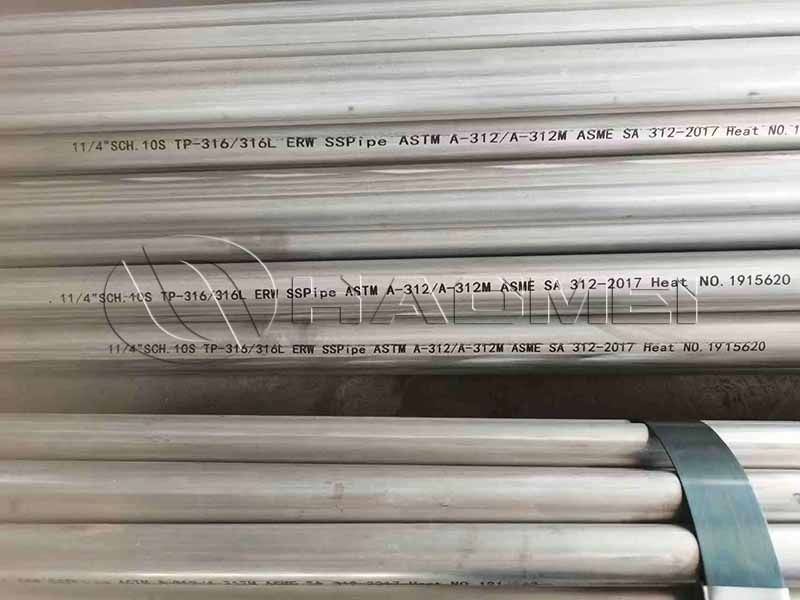
Firstly, strong corrosion resistance. Stainless steel pipes contain chromium, nickel, molybdenum and other alloying elements. Chromium forms a dense passivation film on the surface, which isolates corrosive media from the metal substrate and prevents oxidation and corrosion. Even if the film is slightly damaged, it can self-repair quickly in oxygenated environments, especially resisting pitting and crevice corrosion caused by chloride ions.
Secondly, excellent mechanical properties and temperature-pressure resistance. With high strength and good toughness, stainless steel pipes can adapt to the alternating high-pressure, high-temperature and low-temperature conditions of offshore platforms. They can withstand pressure impacts and thermal expansion/contraction stresses without easy deformation or cracking. Also, they have good high-temperature resistance for long-term oil and gas transportation, and won't suffer brittle fracture at low temperatures, meeting diverse transportation needs of offshore platforms.
Thirdly, clean, eco-friendly and low-maintenance. Their smooth surface resists scaling and microbial adhesion, ensuring media cleanliness, making them ideal for transporting oil, gas, drinking water and other high-purity media. With a service life of over 20 years (far longer than ordinary carbon steel pipes), they only need simple cleaning and inspection for routine maintenance, avoiding frequent replacements and greatly reducing maintenance costs and downtime losses of offshore platforms.
Fourthly, lightweight and easy to install. Compared with carbon steel pipes, stainless steel pipes have lower density and higher strength. Under the same pressure, they have thinner walls and lighter weight, reducing the load on offshore platforms and cutting construction structural costs. Besides, their mature welding and installation processes are suitable for the narrow working spaces of offshore platforms, improving construction efficiency and shortening the construction cycle.
Given the corrosive characteristics of offshore platforms, not all stainless steels can meet the requirements. TP316L and ASTM A790 UNS S31803 (2205 duplex stainless steel) are the two most widely used and best-suited alloys. Below, we introduce their characteristics and application scenarios on offshore platforms.
TP316l is a low-carbon version of 316 stainless steel, belonging to austenitic stainless steel. It is the most widely used basic corrosion-resistant stainless steel pipe material on offshore platforms. Its core advantages lie in its high cost-effectiveness and strong applicability, meeting the basic piping needs of most offshore platforms.
In terms of application scenarios, TP316L stainless steel pipes are mainly used in seawater cooling systems, domestic water pipelines, fire-fighting pipelines, and auxiliary pipelines for oil and gas transportation on offshore platforms. In these scenarios, the pipelines mainly come into contact with seawater, fresh water, and mildly acidic media, where the corrosion is relatively mild.
TP316L, with its stable corrosion resistance and good processing performance, can meet long-term service requirements. Furthermore, TP316L stainless steel pipes are easy to polish and clean, making them suitable for piping systems on platforms where media cleanliness is required.
ASTM A790 UNS S31803, also known as 2205 duplex stainless steel, is an austenitic-ferritic duplex stainless steel. Compared to TP316L, it offers superior corrosion resistance and mechanical properties, making it specifically designed for extreme corrosive environments such as offshore platforms and the preferred material for demanding conditions.
In terms of mechanical properties, 2205 duplex stainless steel is 1.5-2 times stronger than TP316L, with a yield strength exceeding 450 MPa. It can withstand higher pressure and stress, allowing for further reduction in pipe wall thickness under the same pressure conditions, enabling lightweight design and reducing platform load. Simultaneously, its excellent temperature resistance allows for long-term service within a temperature range of -50℃ to 300℃, meeting the diverse needs of high-temperature oil and gas transportation and low-temperature cooling media transportation on offshore platforms.
Original source: https://www.marinesteelpipe.com/a/what-are-corrosion-resistant-stainless-steel-tubing-for-offshore-platforms.html


没有评论:
发表评论