Decorative aluminium strips are selected for visible edges, trims, ceilings, furniture profiles, appliance panels, signage, and interior wall systems. The main purchasing concern is not only price. It is surface consistency: color, gloss, grain direction, flatness, and scratch control across repeat orders.
For volume programs, define the appearance standard before negotiating tonnage. A low unit price loses value if batches differ after installation.
Specify Appearance Before Price
Start with a sample approval process. Keep one signed master sample, one working sample for incoming inspection, and one retained sample at the mill or service center. Record alloy, temper, coating system, gloss, color code, film thickness, protective film type, and grain direction.
| Control point | Practical specification | Why it matters |
|---|---|---|
| Alloy | 1050, 1060, 1100, 3003, 3004, 3105, 5052 | Balances formability, strength, corrosion resistance |
| Temper | O, H14, H16, H18, H24 | Controls bending, springback, and dent resistance |
| Thickness | Common decorative range: 0.20-2.00 mm | Affects rigidity, cost, and slitting stability |
| Width tolerance | Define per EN 485 or ASTM B209 purchase terms | Prevents edge gaps in trim systems |
| Coating thickness | State primer plus topcoat target | Controls weathering and abrasion life |
| Gloss | Define measurement angle, often 60 degrees | Prevents visible panel mismatch |
| Color tolerance | Use CIELAB Delta E method | Creates an objective acceptance rule |
Aluminum has a density of about 2.70 g/cm3, roughly one-third that of steel. Its elastic modulus is about 69 GPa, so wider trims may need ribs, backing, or thicker gauge to avoid waviness. Thermal expansion is about 23 x 10^-6 /K, which matters for long facade and ceiling runs.
Alloy, Finish, and Application Choices
Decorative aluminum trim materials are usually made from rolled input metal, then degreased, chemically pretreated, coated or anodized, cured, slit, leveled, protected, and packed. The right route depends on appearance, forming, and exposure.
| Finish route | Strengths | Watch points | Typical use |
|---|---|---|---|
| PE coating | Economical, good indoor color range | Limited outdoor durability versus fluorocarbon systems | Furniture, interior trim, ceilings |
| PVDF coating | Strong UV and weather resistance | Higher cost, color matching needs strict control | Facades, exterior signage, canopies |
| Anodizing | Metallic look, hard oxide surface | Color range and bending need validation | Elevator trim, electronics, premium interiors |
| Wood grain transfer | Natural decorative effect on metal | Grain repeat and batch tone must be controlled | Doors, windows, wall decoration |
| Brushed or mirror finish | High visual impact | Fingerprints and handling scratches | Appliances, retail display, interior panels |
For exterior projects, fluorocarbon coating is often specified because PVDF resin systems have strong weathering performance. When color retention is critical, review PVDF Coated Aluminium Coil Sheet options, coating warranty conditions, and pretreatment chemistry.
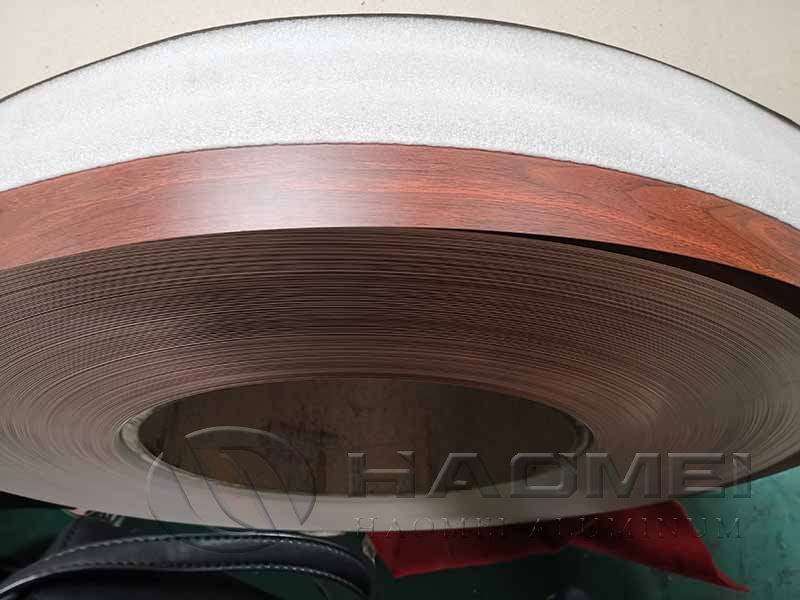
For warm interior design, wood effects can replace natural timber while improving dimensional stability and fire-related project control when combined with approved substrates. A prefinished Wood Grain Aluminum Trim Coil is commonly slit into narrow decorative profiles after pattern approval.
Use standards as contract language, not as decoration. ASTM B209 covers aluminum and aluminum-alloy flat rolled products in the United States. EN 485 covers mechanical properties and dimensional tolerances for aluminum rolled products in Europe. EN 573-3 defines chemical composition. EN 1396 is widely referenced for coated aluminum products for building use. AAMA 2603, 2604, and 2605 are often used to classify organic coatings on architectural aluminum; confirm the project scope because these standards were developed for architectural aluminum finishing.
Compliance should be documented, not assumed. Ask for mill test certificates, RoHS and REACH declarations where applicable, coating technical data sheets, safety data sheets, and packaging declarations for wood pallets under ISPM 15 when exporting.
Cost, Supply Chain, and Inspection Checklist
The usual price formula is aluminum base price plus regional premium plus conversion cost plus coating, slitting, packing, financing, and freight. The aluminum base is commonly referenced to LME official prices, which are published daily by the London Metal Exchange. Regional premiums are published by recognized price reporting agencies such as Fastmarkets, Platts, and Argus; contract terms should state which reference is used.
| Cost element | What to verify | Risk if ignored |
|---|---|---|
| Metal base | Pricing date, average period, currency | Unexpected invoice movement |
| Regional premium | Duty status, origin, delivery region | Hidden import cost |
| Conversion | Alloy, temper, thickness, width, MOQ | Quote not comparable |
| Coating | Resin type, paint brand, film thickness | Poor color life or adhesion |
| Slitting | Burr height, camber, edge condition | Assembly scratches and jamming |
| Packaging | Eye-to-wall or eye-to-sky, pallet, VCI paper | Transit dent, water stain |
| Freight | Incoterms 2020, port congestion, insurance | Delayed project handover |
Market cycles matter. Aluminum prices respond to power costs, alumina supply, smelter curtailments, exchange inventories, interest rates, and construction demand. Coated decorative products add another cycle: paint resin, solvents, pigments, protective film, and container freight. For annual programs, reduce volatility by agreeing on a pricing formula, monthly metal adjustment, and fixed conversion charge.
Supply chain planning should separate metal lead time from finishing lead time. Standard alloy and color may ship faster. Custom color, special gloss, embossed texture, or wood pattern approval can add sampling and curing trials. Narrow-width slit products also need edge protection because handling damage rises as width decreases.
Use this inspection plan before shipment:
- Confirm purchase order against approved drawing: alloy, temper, thickness, width, inner diameter, outer diameter, surface, packing.
- Check certificate values against ASTM B209, EN 485, or agreed standard.
- Measure thickness at edge and center with calibrated instruments.
- Inspect color by spectrophotometer using the agreed Delta E limit.
- Measure gloss at the stated angle.
- Test coating adhesion by cross-cut method where specified, such as ISO 2409 or ASTM D3359.
- Bend a sample to the required radius and inspect for cracking.
- Check burr, camber, telescoping, coil collapse, scratches, dents, water stains, and protective film adhesion.
- Photograph package markings before loading.
- Record batch number for traceability after installation.
| Defect | Likely cause | Corrective action |
|---|---|---|
| Color difference | Paint batch change, oven variation | Freeze approved sample and Delta E limit |
| Edge burr | Worn slitting knives, wrong clearance | Define burr limit and knife maintenance |
| Wavy edge | Residual stress, poor leveling | Require tension leveling and flatness check |
| Coating peel | Weak pretreatment, under-cure | Audit pretreatment and curing temperature |
| Water stain | Condensation during transport | Use dry packing, desiccant, sealed storage |
| Surface scratches | Handling or hard particles | Require protective film and clean rollers |
Release a lot only when documents, dimensions, surface appearance, packaging, and traceability match the approved control plan.
 are really various: white powder coated aluminium, black trim coil, brown aluminum trim coil,copper colored aluminum coil, gold trim coil,etc. It also has different patterns like wood grain, stone gran, brick pattern, camouflage, fabric pattern,etc.
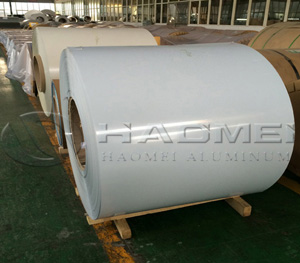 There are four types: PVDF color coated aluminum coil,


