What Are Aluminum Alloys of Aluminium Roil Battery

 Batteries are used to store electricity. In terms of application, they are all energy storage. Therefore, it can be said that all lithium batteries are energy storage batteries. Later, in order to distinguish applications, they were divided into three types: consumer batteries, power batteries and energy storage batteries.

Aluminum foil battery has the characteristics of good conductivity, soft texture, cost advantage, stable performance under high potential and not easy to oxidize. Currently, the battery aluminum foil produced in the market is mainly made of 1060, 1070, 1100, 1235 and other alloys, and the above alloys all belong to the 1000 series. This series of alloys contains a large amount of aluminum, and the purity can reach more than 99.00%.
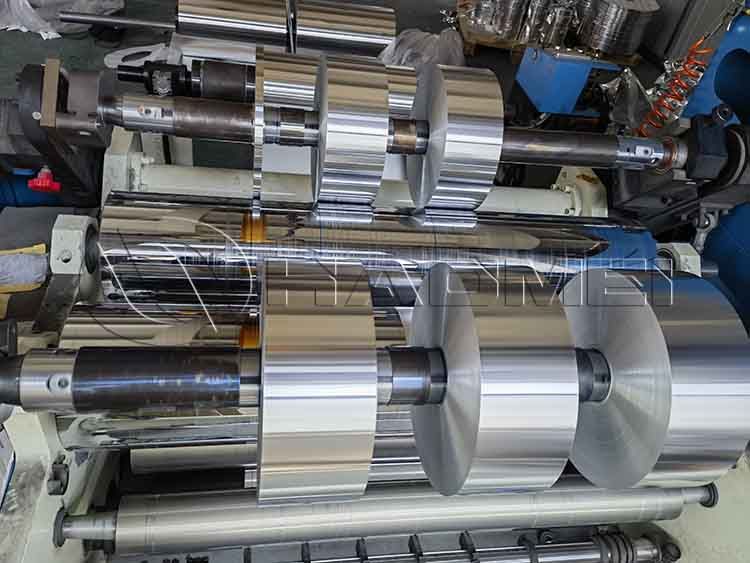
Aluminum foil battery.jpg

1235 aluminum foil has relatively high purity and good electrical conductivity, so it is often used as battery foil. Battery grade aluminium foil is a precision-processed product among aluminum foils. It has very high precision requirements for the performance and quality of aluminum foil. Therefore, the processing of battery foil is more difficult and the process requirements are higher.

The minimum thickness of Haomei Aluminum’s 1235 aluminum foil is 0.014 mm with a strength of over 180 Mpa and its surface dyne value is very high.

The battery foil thickness and rolling accuracy are close to those of traditional light gauge foil. Battery foil's surface and precision requirements are significantly higher than those of traditional aluminum foil, and certification is difficult. Battery foil has requirements for tensile strength, elongation strength, pinholes, trimming, burrs, crown rate, etc.

Its production process is also very complex, which involves multiple rolling processes and heat treatment processes such as alloy casting, homogenization, casting and rolling, cold rolling, intermediate annealing, foil rolling, etc., and each node is interlocked. Based on this, the yield rate of battery aluminum foil production lines is generally not high. Haomei Aluminum can reach 70%.

The production process of battery aluminum foil blanks is divided into three methods: ingot hot rolling (DC), two-roll continuous casting and rolling (CC), and Hazmont continuous casting and rolling strip blanks. Ingot hot rolling and double-roller continuous casting and rolling are mainly used at home and abroad, and Hatzmont's production method is rarely used.

The thickness of aluminum foil and battery is generally at the micron level, and the properties of aluminum foil manufactured by different processes have significant differences. There are many factors that affect the mechanical properties of aluminum foil, such as chemical composition, morphology and size distribution of second phase compounds, and texture.
Original source: https://www.hmaluminumsupply.com/a/what-are-aluminum-alloys-of-aluminium-roil-battery.html

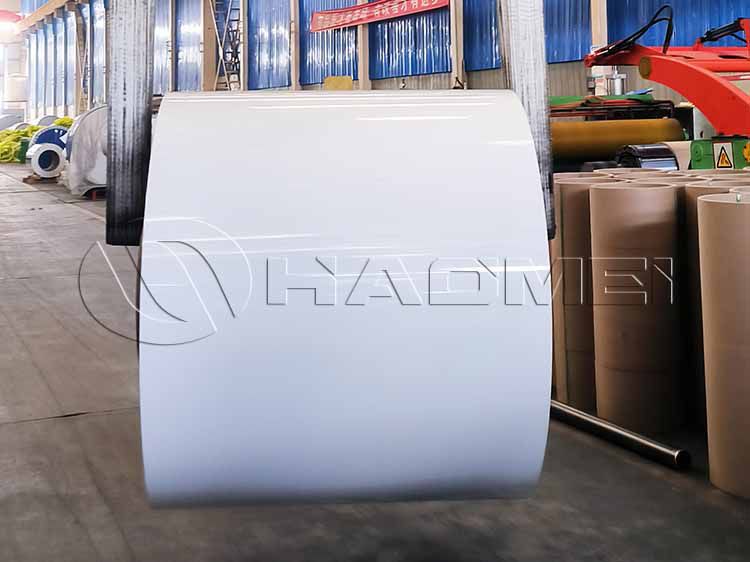
White Aluminum Channel Letter Coil

 The aluminum channel letter coil usually chooses 1050, 1060, 3003, 3105 and 5005 alloy. The choice depends on the surroundings. The tempers are H24, H26, H34. The thickness is 0.5mm, 0.6mm, 0.8mm and 1.0mm. The width is 30mm-500mm. The surface treatment includes coated, brushed, anodized and mirror finish.

The bath liquid for electrolytic coloring is mainly Ni salt, Sn salt and Ni-Sn mixed salt. Others with industrial applications include Fe, Mn, Cu salt, etc. The color is still mainly light tones, and dark colors include bronze, maroon, etc., but not much. However, the color of electrolytic coloring is very stable and light-resistant. After all, it is salt and an inorganic component.

aluminum channel letter coil.jpg

The brushed aluminum strip now adopts double-roller rolling. The reduction amount of aluminum strip rolling should be controlled within the range of 12-16% according to the thickness of the aluminum strip, that is, the distance between the surfaces of the two rolling rollers is 84-88% of the thickness of the aluminum strip, so that the aluminum strip can produce a certain amount of plastic deformation and the convex and concave stripes on the roller are reversely printed onto the aluminum tape to form uniform and fine lines. The traveling speed of aluminum strip rolling is 100-150m/min.

The two main types of paint for color-coated aluminum strips are fluorocarbon (PVDF) and polyester (PE). The colors and effects of the paints can be the same, but the price difference between the two is not small. This is mainly because the paint costs are quite different. Fluorocarbon paint contains fluorine, which has better weather resistance, longer service life, and higher prices.

The type and thickness of coating depends on the balance between cost-effectiveness and performance. The service life depends on many factors, such as outdoor exposure conditions, cleaning and keeping the surface free of long-term contact with corrosive materials. Proper maintenance of its surface can extend its service life.

The price of aluminum strips of the same alloy will be affected by different widths and packaging methods. In principle, the smaller the width and the smaller the inner diameter, the higher the price. The common width is above 200 mm, and the commonly used inner diameter is 500 mm. Therefore, it is recommended that if the user has no clear requirements for the inner diameter, an inner diameter of 500 mm can be selected, and the width needs to be determined according to the actual need. The white aluminum strips are the common choice, so Haomei Aluminum usually have its stock. Welcome to leave message below to inquire what you need.

Original source: https://www.aluminumstrip24.com/news/white-aluminum-channel-letter-coil.html

Aviation Aluminum Alloy 2024 7075

 Aluminum alloys are one of the most widely used materials in aviation field. hey have good mechanical properties and process characteristics, and are characterized by high strength, light weight, and good toughness. They are one of the most important members of the civil aircraft structural material family.

The main features of Al alloy 2024 are large-scale and integrated, thin-walled and lightweight, precise cross-sectional dimensions and geometric tolerances, and uniform and high-quality structural properties. Aluminum alloys used in aerospace are mainly high-strength aluminum alloys, heat-resistant aluminum alloys, and corrosion-resistant aluminum alloys. High-strength aluminum alloys are mainly used in aircraft fuselage components, engine nacelles, seats, control systems, etc.

Al alloy 2024.jpg

Al alloy 2024 is a typical hard aluminum alloy in the aluminum-copper-magnesium system. It contains 4.5% copper, 0.6% manganese and 1.5% magnesium. Its composition is reasonable and its overall performance is good. It is the most heavily used among the duraluminum alloys. 2024 aluminum alloy is commonly used in T3 and T4 tempers, which have high plasticity, fatigue life, fracture toughness and resistance to fatigue crack growth, but poor corrosion resistance.

2024 T3 aluminum not only has high strength, but also has excellent fatigue resistance. Welding is generally not recommended. Typical uses for 2024-T3 Alclad aluminum sheet are fuselage and wing skins, roofs, aircraft structures, and repair and restoration. Its ultimate strength is 62,000 PSI and shear strength is 40,000 PSI.

Aircraft manufacturers use high-strength alloys (mainly Alloy 7075) to strengthen aluminum aircraft structures. Aluminum alloy 7075 has copper (1.6%), magnesium (2.5%) and zinc (5.6%) for ultimate strength, but the copper content makes it very difficult to weld. 7075 aluminum has the best machining performance and can achieve very good results. The ultimate strength is 33000 PSI(-0) and 82000 PSI(-T6), and the shear strength is 22000 PSI(-0) and 49000 PSI(-T6).

7075 aluminum sheet’s common tempers are T6, T73, T76 and T74. 7075 t6 alloy has the highest strength, low fracture toughness, and is sensitive to stress corrosion cracking. It is generally not recommended for use in low temperature applications. The thermal conductivity of the material is related to its state. At 25℃, the thermal conductivity of the 7075-t6 is 124W/(m·℃), while that of the T73 material is higher, 156W/(m·℃). The specific heat capacity of 7075-T6 alloy (at 25℃) is 796J/(kg·℃).

Original source: https://www.aircraft-aluminium-sheet.com/a/aviation-aluminum-alloy-2024-7075.html

What Are 6061 6016 Aluminum Properties

 Automobile aluminum sheet is a material widely used in automobile manufacturing industry. It has the characteristics of lightweight, high strength, corrosion resistance and good forming performance. Automobile aluminum sheet usually adopts high-strength aluminum alloy materials, such as 5000 series, 6000 series and 7000 series.

Nowadays, automobile wheels are basically made of aluminum. Cars without aluminum wheels are either cars from more than ten years ago or very low-priced cars. The use of aluminum alloy wheels has a very obvious effect on reducing fuel consumption of cars, and automobile wheels are mostly made of 6061 aluminum alloy.

6016 aluminum properties.jpg

Common alloys for aluminum tubular busbars are 6063, 6061 and 6101 aluminum plate. 6063 alloy is widely used in outdoor high-voltage substation busbars due to its excellent mechanical and electrical properties. In the case of high strength and low conductivity, 6061 aluminum alloy busbar tubes are used. What are aluminium 6061 t6 properties?

6061 aluminum alloy has great advantages in making automobile body sheet parts. Body sheet parts affect the manufacturing of the entire body to some extent, so the selection of materials is also very important. AL-Mg-Si deformable alloy is a heat-treated strengthening alloy. Heat treatment after alloy formation has an important influence on the performance of the product, among which the greatest influence is the solid solution effect in the heat treatment system.

6000 series deformable aluminum alloy automobile sheet uses silicon and magnesium as the main alloying elements and is an aluminum alloy that can be heat-treated and strengthened. This type of aluminum alloy sheet has good formability in the pre-treated state, no yield point elongation, is suitable for automobile outer panels, and has baking hardening properties. It has high rheological stress after paint baking, and the parts have high dent resistance.

The outer panels of the car body are mainly 6016, 6111 and 6022 alloys. The size of aluminum alloy sheets for car bodies is mainly concentrated in thickness 0.7-3mm and width 900-2130mm. One of the main characteristics of 6016 aluminum sheet is its formability. What are 6016 aluminum properties?

6016-T651 is the main alloy of 6016 alloy. It is a high-quality aluminum alloy product produced by heat treatment pre-stretching process. Although its strength cannot be compared with 2XXX series or 7XXX series, it has many characteristics of magnesium and silicon alloys, and has excellent machinability, excellent electroplating properties, good corrosion resistance, high toughness, no deformation after processing, dense material, easy polishing, easy color film, oxidation effect and other excellent characteristics.

Original source: https://www.aluminium-auto-sheet.com/a/what-are-6061-6016-aluminum-properties.html

Marine Grade Aluminum 5052 5083

 Aluminum 5052 was developed in the United States in the 1930s. 5052 alloy is a deformed alloy that belongs to the 5000 series aluminum. It is often called aluminum-magnesium alloy. Because magnesium is the main alloying element in this alloy after aluminum.

Marine grade aluminum 5052 is mainly composed of aluminum, magnesium and a small amount of chromium, and has high corrosion resistance and weldability. The hardness of 5052 aluminum alloy is relatively low, usually with a Brinell hardness of around 60 in hardness tests. 5052 aluminum plates are generally in H112, H24, and H32 tempers.

5052-h32 represents an annealing process that accounts for a large proportion of the entire use. This annealing temperature is generally direct annealing at 420-475 degrees Celsius, which has the advantages of high temperature resistance, corrosion resistance, and oxidation resistance.

marine grade aluminum 5083.jpg

5083 aluminum plate, which belongs to the 5 series aluminum-magnesium alloy, is currently widely used on ships and yachts. Most of the medium-thick aluminum plates are used. The commonly used are H111, H112, H116 and H321. It is an aluminum alloy material commonly used by domestic and foreign shipbuilding companies.

The maximum magnesium content (mass fraction) of 5052 aluminum alloy with low magnesium content is only 2.8%, and the maximum magnesium content of 5083 aluminum alloy with the highest magnesium content is 4.9%.

Although the strength properties of the alloy increase due to the increase in magnesium content, the plasticity and corrosion resistance decrease significantly. Especially for aluminum alloys with w (Mg) > 6%, the process plasticity decreases particularly strongly.

Although 5052 aluminum is easier to process and form, marine grade aluminum 5083 can provide approximately 1.5 times the tensile and yield strength. When other conditions such as thickness are the same, a boat made of 5083 aluminum alloy can withstand greater pressure than a boat made of 5052 aluminum alloy when hit without breaking or deforming.

5052 aluminum alloy is suitable for the manufacture of economical aluminum alloy boats. The aluminum plate specifications used in this aluminum alloy boat are 2*2000*9000mm. Ocean yachts require 5083 aluminum plates. In shipbuilding, 5083 aluminum plates are often used to process multiple parts such as hulls, operating tables, and decks.

Original source: https://www.marine-aluminium-plate.com/a/marine-grade-aluminum-5052-5083.html

4x10 Diamond Pattern Aluminum Sheet Metal

 There are several conventional sizes for processing: 4x8, 4x12, 5x10, 5x12 and 4x10 aluminum sheet metal. 4x10 aluminum sheet refers to 4 foot x 10 foot, which is 1219mm x 3048mm. Since aluminum tread plate is often used as the floor or platform, so it is often needed in such size.

Aluminum tread plate for stair is a kind of anti-skid aluminum sheet used on stairs and its main function is to prevent slipping. The Patterned stair treads are more decorative and more beautiful than other types of anti-skid plates, so they are often used in some large places with a lot of people, such as shopping malls and supermarkets.

4x10 aluminum sheet metal.jpg

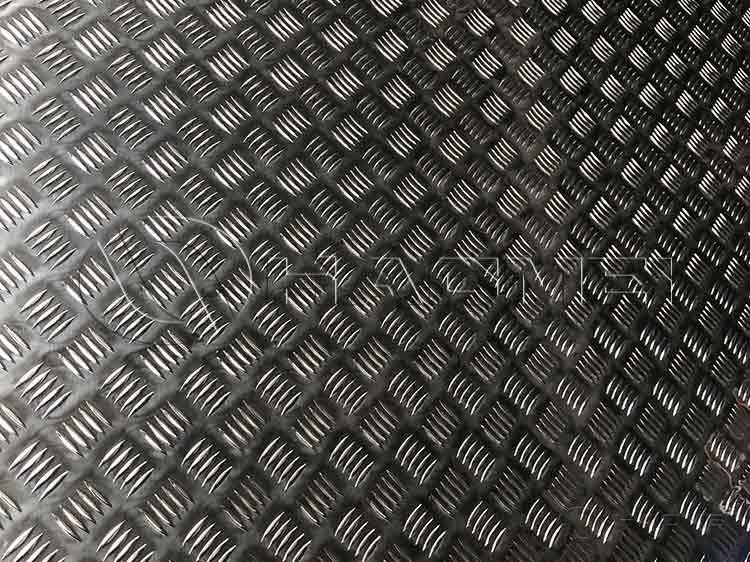
We can often see the anti-skid aluminum plate at the bottom of the car when we take the bus. This kind of anti-skid plate can choose 5 bar aluminum tread plate. Because the five high and low stripes are arranged relatively parallel, and the intersection angle of each stripe with other stripes is 60-80 degrees, this pattern has excellent anti-skid effect. This kind of aluminum plate is widely used as an anti-skid material and has obvious anti-skid effect.

Diamond pattern aluminum sheet is pressed by embossing equipment and is a kind of embossed aluminum plate. The surface is diamond-shaped and has a certain decorative effect. It is suitable for use in luggage manufacturing, product packaging and other industries. It is acid-resistant and corrosion-resistant, with a lasting luster and beautiful patterns.

Patterned aluminum plates are divided into pure aluminum sheet and aluminum alloy sheet. The alloys are 1050, 1060, 1100, 3003, 3105, 5052, 5083, 5754, 606, 2024, 8011, 5086, etc. Among them, the most commonly used patterned aluminum plates are 1100, 1050, 1060, 3003, 5052, 5083, 6061.

At present, users in the market do not have high requirements for the mechanical properties and mechanical properties of aluminum diamond plate, so he quality of patterned plates is mainly reflected in the pattern formation rate, pattern height, and pattern height difference. As for the commonly used patterned plates in the market, the thickness is mostly 2-8mm. Welcome to leave message below to inquire what you need.

Original source: https://www.hm-alu.com/a/4x10-diamond-pattern-aluminum-sheet-metal.html

Aluminum Material Grades 6061

 In the field of aerospace, 6061 aluminum sheet for sale is widely used in the manufacture of aircraft fuselages, aircraft parts and missile components. Its excellent fatigue resistance and corrosion resistance make it the first choice for aviation materials. In the field of automobile manufacturing, 6061 aluminum alloy is usually used in the manufacture of automobile frames, bodies and engine parts, which can effectively reduce automobile weight, improve fuel efficiency and reduce exhaust emissions.

6061 aluminum sheet for sale.jpg

6061-t651 features

1. Chemical composition: The main chemical components of 6061-T651 aluminum are aluminum (Al) and magnesium (Mg), and a small amount of silicon (Si) and copper (Cu). The ratio of these elements makes 6061-T651 aluminum sheet and profile have excellent mechanical properties and corrosion resistance.

2. Mechanical properties: 6061-T651 aluminum has good strength, plasticity and toughness, which can meet the needs of various complex shapes and high-strength structural parts. Its tensile strength and yield strength are higher than ordinary aluminum.

3. Processing performance: 6061-T651 aluminum is easy to process and can be processed by cutting, drilling, bending and welding. In addition, its surface treatment performance is good, and spraying, anodizing and other processes can be used as needed to improve its corrosion resistance and aesthetics.

Applications of 6061 alloy

1. Automobile industry

In the automobile manufacturing industry, 6061-T651 aluminum rod is widely used due to its light weight and high strength. First, it is often used to manufacture the body structure parts of the car, such as doors, hoods and trunk lids, to reduce the overall weight of the vehicle, thereby improving fuel efficiency and reducing emissions.

Secondly, 6061-T651 aluminum is also often used to manufacture suspension systems, brake systems and engine components, which need to withstand high mechanical and thermal stresses, and the high strength and good heat resistance of 6061-T651 aluminum can just meet these needs.

2. Aerospace Industry

In the field of aerospace, the application of 6061 aircraft aluminum is more extensive and critical. Due to its high strength, low density and excellent corrosion resistance, it is an ideal material for manufacturing aircraft fuselages, wings, landing gear and other key components.

For example, 6061-T651 aluminum rod can be used to manufacture aircraft skins and frames to provide sufficient strength and rigidity, while reducing the overall weight of the aircraft and improving flight efficiency and range. In addition, its excellent corrosion resistance also extends the service life of aircraft in various harsh environments.

Precautions for the use of 6061-T651 aluminum sheet

Processing: During the processing, the sharpness of tools and machines should be ensured, and the blades should be replaced regularly to avoid excessive heat that causes the material to soften. In addition, the coolant should be kept clean and replaced in time to ensure the cooling effect.

Welding: Before welding, the oil and impurities on the surface of the material should be removed to ensure the welding quality. At the same time, appropriate welding wire and welding parameters should be selected, and sufficient preheating and post-welding cooling should be carried out to avoid welding cracks.

Storage: During storage, aluminium material grades should be stored in a dry, well-ventilated place and avoid contact with corrosive substances. At the same time, the surface quality of the material should be checked regularly to ensure that it is not damaged or corroded before use.


Original Source:https://www.aircraftaluminium.com/a/aluminum-material-grades-6061.html

Mill Finish Aluminum Circle VS Color-Coated Aluminum Circle: Which Is Better for Cookware

  Aluminum circles are the core raw materials for manufacturing various cookware, including pots, pans, woks, and pressure cookers. Their su...